Will artificial intelligence replace humans in the future? Learn how AI is transforming jobs, industries, and why human skills still remain essential today.
Can Artificial Intelligence Replace Humans in the Future?
Artificial Intelligence (AI) is growing at an extraordinary speed. From smartphones to smart homes, AI is integrated into our daily lives. Businesses are using AI for automation, healthcare is using AI for diagnosis, and education is using AI for personalized learning. This rapid development raises a major question: Can Artificial Intelligence replace humans in future?
The debate about artificial intelligence replacing humans is becoming stronger every year. Some believe AI will dominate the workforce, while others argue that humans will always remain essential.
What Is Artificial Intelligence?
Artificial Intelligence refers to machines or software systems that can perform tasks requiring human intelligence. These tasks include learning, reasoning, problem-solving, and decision-making.
AI works through technologies like:
- Machine Learning
- Deep Learning
- Natural Language Processing
- Automation Systems
The future of artificial intelligence looks powerful and promising.
👉 Definition of Artificial Intelligence – Britannica
How AI Is Already Replacing Jobs
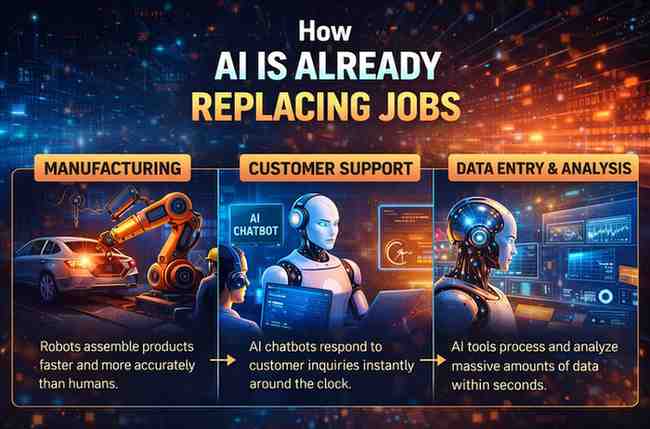
AI replacing jobs is not just a prediction — it is already happening in several industries.
1. Automation in Manufacturing:
Robots are assembling products faster and with greater accuracy than humans. Automation reduces errors and increases production efficiency.
2. AI in Customer Support
AI-powered chatbots respond to customer queries instantly. Many companies now prefer automated support systems.
3. Data Processing and Analysis
AI tools process massive amounts of data in seconds. This reduces the need for manual data entry jobs.
These examples show that AI replacing jobs is already happening in specific sectors.
Why Artificial Intelligence Cannot Fully Replace Humans
Even though AI is advanced, it has limitations that prevent it from fully replacing humans.
a. Emotional Intelligence:
Humans understand emotions, empathy, and relationships. AI cannot genuinely feel emotions or build meaningful human connections..
b. Creativity and Innovation:
AI can generate content and designs, but true originality and innovation come from human imagination.
c. Ethical Judgment:
AI follows algorithms and programming. Humans, however, make decisions based on ethics, culture, and moral values.
d. Complex Problem Solving:
Humans can handle unexpected situations better than machines. Real-life complexity often requires human judgment.
Therefore, AI vs humans is not a competition but a collaboration.
Will AI Create More Jobs Than It Replaces?
Historically, technological advancements have created new career opportunities. When computers were introduced, many feared unemployment. Instead, new industries and jobs emerged.
Similarly, AI is creating demand for:
- AI Engineers
- Data Scientists
- Digital Marketing Experts
- Automation Specialists
- AI Trainers
The future of artificial intelligence is likely to transform job roles rather than eliminate them completely.
Human and AI Collaboration Is the Real Future:-
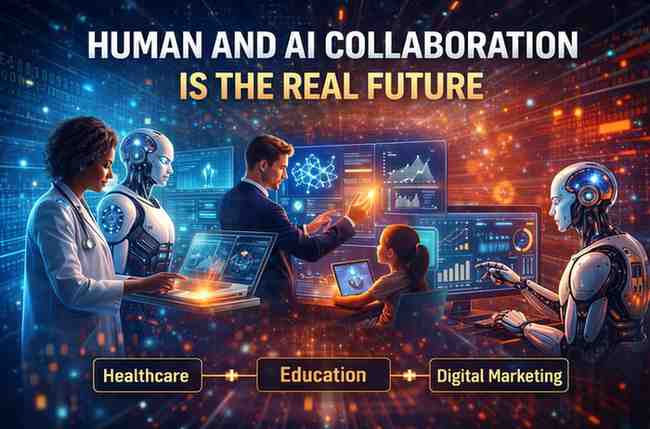
The most realistic scenario is collaboration. AI handles repetitive tasks, while humans focus on creativity, leadership, and strategy.
For example:
In healthcare, AI assists doctors in early disease detection.
In education, AI personalizes student learning experiences.
In digital marketing, AI analyzes consumer behavior for better targeting.
Humans and AI working together create better outcomes than either alone.
How Students and Professionals Should Prepare for an AI-Driven Future
Artificial Intelligence is transforming industries rapidly, so preparing for an AI-driven future is essential. Instead of fearing that artificial intelligence will replace humans, individuals should focus on upgrading their skills.
Learn Digital and AI-Related Skills:
Students should learn basic AI concepts, digital marketing, data analysis, and automation tools. These skills increase employability in the modern job market.
Improve Soft Skills:
While AI can automate technical tasks, soft skills such as communication, leadership, teamwork, and emotional intelligence remain uniquely human strengths.
Focus on Continuous Learning:
Technology evolves quickly. Professionals who commit to lifelong learning will stay relevant and competitive.
Combine Human Creativity with AI Tools:
Using AI tools effectively can enhance productivity. Humans who know how to work with AI will have a strong advantage over those who resist it.
Preparing for the future of artificial intelligence is not about competing with machines. It is about adapting and collaborating with technology for better growth opportunities.
Conclusion:
So, can Artificial Intelligence replace humans in the future?
AI will continue to automate tasks and improve efficiency. However, it cannot fully replace human creativity, empathy, ethical reasoning, and adaptability. The smartest approach is to upgrade skills and adapt to AI-driven changes.
Instead of fearing AI replacing jobs, individuals should focus on learning new digital skills and embracing technology.
The future belongs to those who combine human intelligence with artificial intelligence.